

|
Introduction: Liposuction, known
technically as lipoplasty or suction
lipectomy, is a procedure that can help
sculpt the body by removing unwanted fat
from between the skin and muscle. Depending
on the individual patient, lipoplasty may
result in dramatic changes in your
silhouette by contouring and defining
specific body areas. The most commonly
treated areas in women are the abdomen,
hips, buttocks, thighs, knees, upper arms,
chin, cheeks, and neck. In men, the commonly
areas treated include the love handles,
abdomen, breasts, neck, and chin.
Significant improvements in liposuction
technology have occurred during the last ten
years. One, the tumescent technique, is
routinely used and favored by Dr. Shienbaum,
providing more precise results and a
speedier recovery. Although liposuction is
not a substitute for proper dieting and
exercise, it can remove stubborn areas of
fat that refuse to respond to traditional
weight-loss methods. If you do not gain
excessive weight following your procedure,
liposuction can represent a permanent fat
loss in the areas treated.
Candidates for liposuction: You must
have realistic expectations about what
liposuction can do for you. While the
procedure can enhance your appearance and
help boost self confidence, it won't
necessarily alter your appearance to match
an ideal or unrealistic body shape. You
should seriously consider what you want to
achieve, identify your expectations, and
discuss these with Dr. Shienbaum.
While there is no weight limit for
liposuction, the best candidates are people
with firm, elastic skin who experience
pockets of excess fat in certain areas. Age
also is not a major factor; however, you
should understand that older patients may
have reduced skin elasticity and may not
achieve the same results as a younger
patient with tighter skin. Physical health
is important.
Surgical procedures: As mentioned
above, Dr. Shienbaum is highly trained in
and routinely employs the tumescent
technique for liposuction. This technique is
the most common and is considered the safest
form of liposuction for removing large
amounts of fat because there is minimal
blood loss. In this technique, Dr. Shienbaum
will inject a salt-water solution beneath
the skin in the area to be suctioned. The
solution may contain small amount of a local
anesthetic, usually lidocaine, and the
hormone epinephrine. The anesthetic numbs
the area and reduces postoperative
discomfort, while the epinephrine reduces
bruising and allowing for removal of more
fat during a single procedure.
There is a limit on the amount of fat that
can be removed during a procedure. This is
determined for each individual at your
consultation. Should a larger amount, or
more areas, of fat removal be desired than
can be completed during one treatment, a
second procedure will be required at a later
date.
Removal of the fat cells involves the use of
a micro or small tube, called a cannula,
which is connected to a powerful suction
machine. The cannula is inserted under the
skin through very small incisions. Dr.
Shienbaum strives to keep the incision sites
as inconspicuous as possible for your
procedure. Fat removal is accomplished as
the suction cannula creates tiny 'tunnels'
through the fatty layers; the 'tunnels' then
collapse following removal of the fat.
As with any surgical procedure, liposuction
has certain common side effects, such as
bruising, swelling, and temporary numbness.
Although irregularities of the skin are
possible, this is minimized by use of the
micro cannula.
Planning your surgery: Dr. Shienbaum
and his staff at Brandon Plastic Surgery
welcome you to a complementary initial
consultation during which your desires and
expectations will be discussed. In your
initial consultation, you will visit with
the professional staff that will take your
medical history. The Doctor will evaluate
your health, conduct an examination, and
provide his recommendations on the procedure
most appropriate for you. It is important
for you to be frank with the Doctor and for
you to know that the Doctor will be frank
with you, describing his technique,
alternatives, limitations, and risks. Dr.
Shienbaum also will explain the anesthesia
that will be used during your procedure. The
staff will provide you with the opportunity
to view photos of previous patients so that
you may better comprehend likely results,
information about the facility where your
surgery will be performed, and appropriate
expenses.
Upon your decision to proceed with
lipoplasty, the staff will work with you to
arrange a surgery date, answer any other
questions, review consent forms, and take
photographs. Dr. Shienbaum uses an advanced
digital imagery camera and storage on an
automated imagery filer to immediately
record photographs.
The staff will also provide you with
instructions in preparation for your
surgery. These will include guidance on
eating, drinking, smoking, and the taking or
avoidance of certain medications and
vitamins. You will need to arrange for
transportation from the facility and should
have some assistance to help or to provide
care following your surgery.
Where your surgery will occur? Dr.
Shienbaum will perform your liposuction in a
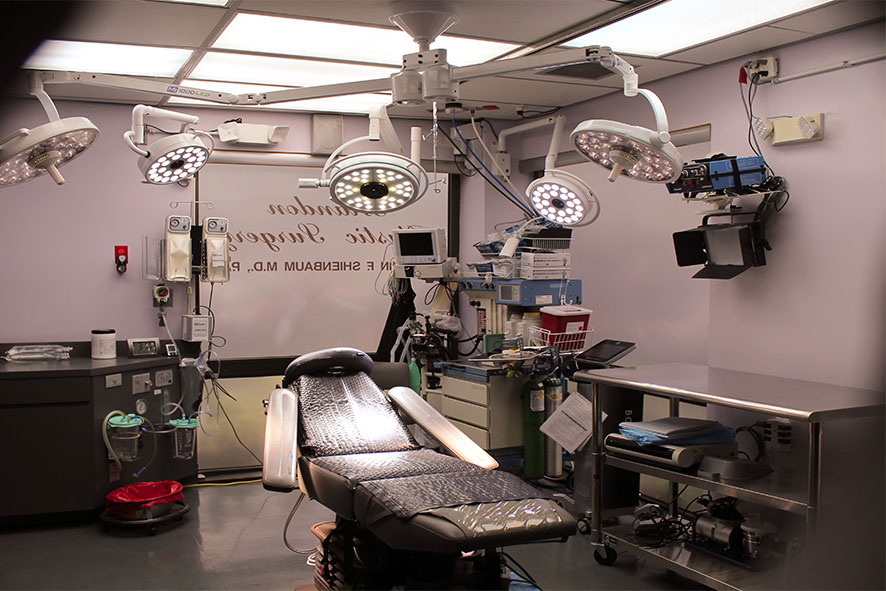
local, fully accredited ambulatory surgical
facility. While this procedure is typically
conducted in an outpatient facility, Doctor
Shienbaum has privileges at area hospitals
where he is recognized as a board-certified
Plastic Surgeon and Otolarnygologist.
Your surgery and anesthesia: Upon
your arrival for your surgery, all
pre-operative laboratory work will be
accomplished. Various types of anesthesia
can be used for liposuction procedures,
which will have been discussed with you and
decided during your consultation. The type
of anesthesia you will receive will provide
the safest and most effective level of
comfort for your surgery. If only a small
amount of fat and a limited number of body
sites are involved, liposuction may be
performed under local anesthesia, which
numbs only the affected areas. For more
extensive procedures, sedatives or general
anesthesia will be the proper choice.
The extent of your specific procedure
requirements will dictate the duration of
the surgery. The time required to perform
liposuction may vary considerably, depending
on the size of the area, the amount of fat
being removed, and the type of anesthesia.
You will be fitted with an elastic
compression garment that will encompass the
portions of your body that were treated.
This ensures proper healing and
minimalization of skin irregularities and
will be worn for several weeks following the
procedure. After completion of your surgery,
you will be moved to a recovery room or
area.
While in recovery, your body will release
itself from the 'anesthetic sleep'. A nurse
will be constantly monitoring your vital
signs, checking for bleeding and drainage
from the incisions, and will ensure that you
are warm and comfortable. Recovery time is
dependent on the anesthesia used and your
individual physiology. A normal recovery
stay of one to two hours should be expected.
A member of Dr. Shienbaum's nursing staff
will contact you in the evening to check on
your status. It is important that you
provide the staff with a contact phone
number.
When you make preparations for your surgery,
arrange for someone to drive you home after
the procedure and, if needed, to help you at
home for a day or two.
After your surgery: You will likely feel
light-headed and sore the first 24 hours
after your procedure and you should expect
some swelling and discomfort. You will be
seen in our office on the day following your
surgery. During this visit you will be
evaluated, your dressings changed, and you
will be provided with further post-operative
instructions, as needed. You will likely
have experienced some fluid drainage from
the small incisions.
You should expect to be up and around in 24
to 48 hours following the surgery. Most
discomfort that you experience will be
controlled by medication, but should subside
within 3 to 4 days. Healing is a gradual
process and is dependent on your individual
physiology, diet, and exercise; you should
start walking around as soon as possible to
reduce swelling and to help prevent blood
clots from forming in your legs. Some
patients experience more soreness than
others, but most are pleased with how
quickly they are able to return to normal
activities. You will begin to feel better
after about a week or two and you should be
back at work within a few days following
your surgery. Any complications noted during
your healing period should be immediately
brought to the attention of Dr. Shienbaum.
Follow-on examinations will be scheduled
based on your personal progress.
The new body contour should emerge in the
first 2 weeks as swelling subsides, but it
is possible some swelling may remain for
several months. You should be able to resume
most non-physical activities within 1 week.
Most patients are completely healed and back
to full activities within 4 to 8 weeks.
Frequently asked questions: This section
provides information in response to
questions or subjects routinely posed by our
patients:
1. Will the fat grow back? Liposuction
involves the permanent removal of fat cells.
While significant amounts of fat can be
removed during a single procedure, not all
fat cells are removed. Therefore, fat cells
remaining in problem areas can eventually
grow with excess weight gain. Ensuring a
healthy diet and maintaining an appropriate
level of exercise will prevent growth of
those cells that remain.
2. How much fat can you remove? The amount,
or volume of fat that can be suctioned is
dependent on each individual's physiology,
presentation, and health. It is important
that you be properly evaluated during your
complementary consultation and that Dr. Shienbaum is fully aware of your medical
history in order to make this determination.
While liposuction techniques have improved
to permit removal of a significant amount of
fat during a single procedure, the surgery
is not a treatment for chronic excessive
obesity.
3. What risk categories may prevent me from
having liposuction? People with certain
medical conditions, including diabetes,
heart disease, lung disease, and poor blood
circulation are at increased risk for
complications from liposuction.
4. Resumption of activities. Dr Shienbaum
recommends a return to as much activity as
is comfortable within 2 to 4 weeks after
your surgery.
5. How will the area treated appear? The
incision scars from liposuction are small,
usually about one half-inch of less, and
strategically placed to be hidden from view.
Imperfections in the final appearance are
not uncommon after lipoplasty and usually
are dependent on the elasticity of the
patient's skin.

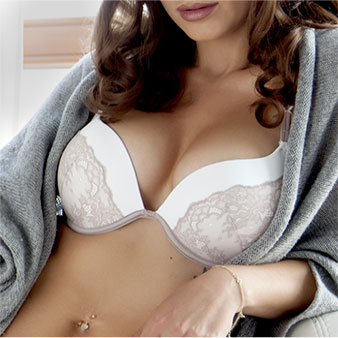
Click the Image Below to
Visit Our Liposuction Gallery
(Back to Top) |