

|
Introduction:
Eyelid surgery, blepharoplasty, is a
procedure to remove fat, and usually excess
skin and muscle, from the upper and lower
eyelids. This surgery can correct drooping
upper lids and puffy bags below your eyes,
features that often make one look older and
more tired, and may even interfere with
proper vision. Blepharoplasty will not
remove crow's feet or other wrinkles,
eliminate dark circles under your eyes, or
lift sagging eyebrows. Blepharoplasty can be
done alone, or in conjunction with other
facial surgery procedures such as a facelift
or browlift. Blepharoplasty is a popular
procedure because we often first see the
signs of aging around our eyes.
Candidates for Blepharoplasty:
Blepharoplasty can enhance your appearance
and your self-confidence, but it won't
necessarily change your looks to match your
ideal, or cause other people to treat you
differently. Before you decide to have
surgery, think carefully about your
expectations and discuss them with Dr.
Shienbaum. The best candidates for eyelid
surgery are men and women who are physically
healthy, psychologically stable, and
realistic in their expectations. Most are 35
or older, but if droopy, baggy eyelids run
in your family, you may decide to have
eyelid surgery at a younger age.
Surgical procedures: Blepharoplasty
normally takes one to three hours to
complete, depending on the extent of the
procedure (upper or lower or both). The
technique used for your surgery is dependent
on your specific anatomy and the desired
results.
Upper Blepharoplasty: During upper
eyelid surgery, Dr. Shienbaum carefully
removes excess tissues to sculpt and
rejuvenate the appearance of the upper
eyelid. Because the incision is hidden
within the eyelid crease itself and is
nearly invisible, a very natural appearance
is possible. Occasionally, the excess skin
in the upper eyelids is actually caused by
sagging of the eyebrows, which then pushes
the skin just below the brows onto the upper
eyelids. In this case, a forehead or brow
lift may be required rather than, or in
addition to, an upper lid blepharoplasty.
Lower Blepharoplasty: During lower
eyelid surgery, Dr. Shienbaum removes or
repositions the fatty tissue that causes
bags under the eyes. This can usually be
performed through a small incision inside
the lower eyelid that is completely hidden.
Occasionally, a patient may have excess skin
or muscle tissue that requires a small
incision under the eyelashes.
Planning your surgery: Dr. Shienbaum
and his staff at Brandon Plastic Surgery
welcome you to a complementary initial
consultation during which your desires will
be discussed. In your initial consultation,
you will visit with the professional staff
that will take your medical history. The
Doctor will evaluate your health, conduct an
examination, and recommend the surgical
technique, which is most appropriate for
you. Dr. Shienbaum also will explain the
anesthesia that will be used during your
procedure. The staff will provide you with
photos of previous patients so that you may
better comprehend likely results. The
facility where your surgery will be
performed will be explained, as will the
expenses involved. Insurance carriers
generally do not cover blepharoplasty, since
they generally deem it to not be medically
necessary.
Upon your decision to proceed with this
procedure, the staff will work with you to
arrange a surgery date, review consent
forms, and take photographs. Dr. Shienbaum
uses an advanced digital imagery camera and
storage on an automated imagery filer to
immediately record photographs.
The staff will also provide you with
instructions in preparation for your
surgery. These will include guidance on
eating, drinking, smoking, and the taking or
avoidance of certain medications and
vitamins. You will need to arrange for
transportation from the facility and should
have some assistance to help or to provide
care following your surgery.
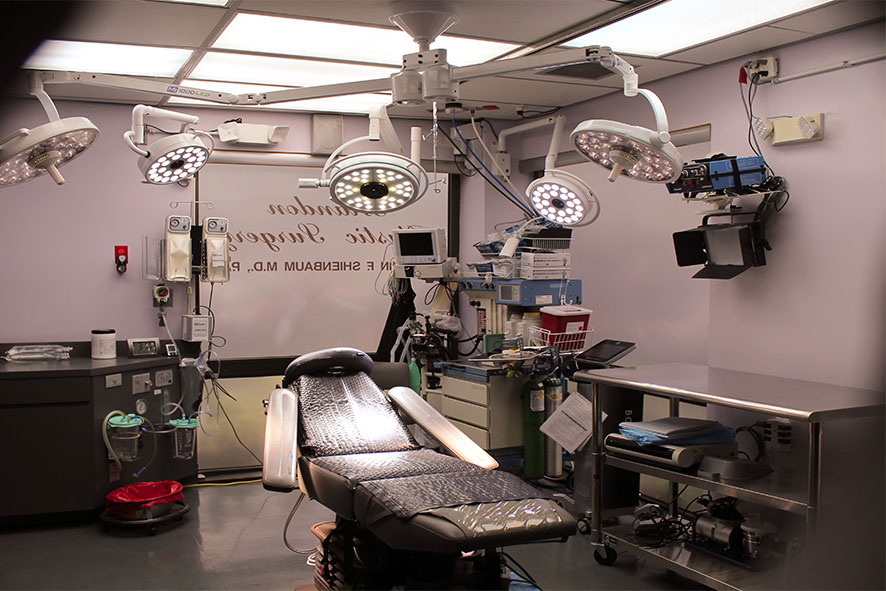
Where your surgery will occur: Dr.
Shienbaum will perform your blepharoplasty
in a local, fully accredited ambulatory
surgical facility. While blepharoplasty is
typically conducted in an outpatient
facility, Doctor Shienbaum has privileges at
area hospitals where he is recognized as a
board-certified Plastic Surgeon and
Otolarnygologist.
Your surgery and anesthesia: Upon
your arrival for your surgery, the
anesthetist will initiate an intravenous
(IV) line. The IV will be used to provide
your anesthesia and appropriate medications
and hydration during the surgery and your
recovery period. Depending on your case and
the facility, either general anesthesia or a
shallower 'sleep', known as IV sedation, are
usually employed.
As previously mentioned, blepharoplasty
usually takes one to three hours, depending
on the extent of the surgery. If you're
having all four eyelids done, Dr. Shienbaum
will usually work on the upper lids first,
then the lower ones. In a typical procedure,
he makes incisions following the natural
lines of your eyelids: in the creases of
your upper lids, and just below the lashes
in the lower lids. The incisions may extend
to the outer corners of your eyes. Working
through these incisions, Dr. Shienbaum
separates the skin from underlying fatty
tissue and muscle, removes excess fat, and
often trims sagging skin and muscle. The
incisions are closed with very fine sutures.
Dr. Shienbaum will lubricate your eyes with
ointment and may apply a bandage After
completion, you will be moved to a recovery
room or area.
While in recovery, a nurse will be
constantly monitoring your vital signs and
will ensure that you are comfortable.
Recovery time is dependent on the anesthesia
used and your individual physiology. A
normal recovery stay of one to two hours
should be expected. A member of Dr.
Shienbaum�s nursing staff will contact you
in the evening to check on your status. It
is important that you provide the staff with
a contact phone number.
After your surgery: You will likely
feel light-headed the first 24 hours after
your procedure. Your eyelids may feel tight
and sore as the anesthesia wears off, but
you can control any discomfort with the pain
medication Dr. Shienbaum prescribes. You
will keep your head elevated for several
days, and use cold compresses to reduce
swelling and bruising. Bruising varies for
each patient, but normally reaches its peak
during the first week and resolves within
two weeks to a month. You'll be shown how to
clean your eyes, and use the prescribed eye
ointment, since your eyelids may feel dry at
first and your eyes may burn or itch. For
the first few weeks you may also experience
excessive tearing and sensitivity to light.
Temporary changes in your eyesight, such as
blurring or double vision, have been
reported. Any complications noted should be
immediately brought to the attention of Dr.
Shienbaum.
You will be seen in our office on the day
following your surgery. During this visit
you will be evaluated and provided with
further post-operative instructions, as
needed. Dr. Shienbaum will follow your
progress very closely and sutures normally
will be removed within a week after surgery.
Once they're out, the swelling and
discoloration around your eyes will
gradually subside.
You should expect to be up and around in 24
to 48 hours following your surgery. You
should be able to read or watch television
after two or three days, keeping activities
minimal for three to five days, and
conducting no strenuous activities for about
three weeks. If you are a contact lens
wearer, you won't be able to insert lenses
for at least two weeks, and even then they
may feel uncomfortable. Most patients are
ready to go out in public (and back to work)
in a week to 10 days. By then, depending on
your rate of healing and Dr. Shienbaum's
instructions, makeup to hide remaining
bruising may be applied. You may be
sensitive to sunlight, wind, and other
irritants for several weeks, so you should
wear sunglasses and a sunblock when you go
outdoors. Healing is a gradual process, and
your scars may remain slightly pink for six
months or more after surgery. Eventually,
though, they'll fade to a thin, nearly
invisible white line.
Frequently asked questions: This
section provides information in response to
questions or subjects routinely posed by our
patients:
1. Post-operative effects. The
post-operative effects are minimal and
temporary. Minor swelling, bruising and
discomfort should disappear within two
weeks. Cold compresses will help alleviate
these side effects.
2. Wrinkles around eyes. The blepharoplasty
procedure will not eradicate the wrinkles
around the eyes (crow's feet) nor will it
elevate droopy eyebrow. There are other
procedures designed for these purposes.
3. Complications. All patients will
experience some bruising and swelling for a
few days after the surgery. In addition, a
temporary problem with closure of the
eyelids is usually seen. Some patients may
have temporary blurring of their vision,
usually due to the ointments applied to the
incisions post operatively. The theoretical
complications of any surgical procedure,
such as bleeding, infection, wound
disruption and heavy scarring are also
possible, but extremely rare.
(Back to Top) |